AI made Meta creative cheap. Picking the winner still costs.
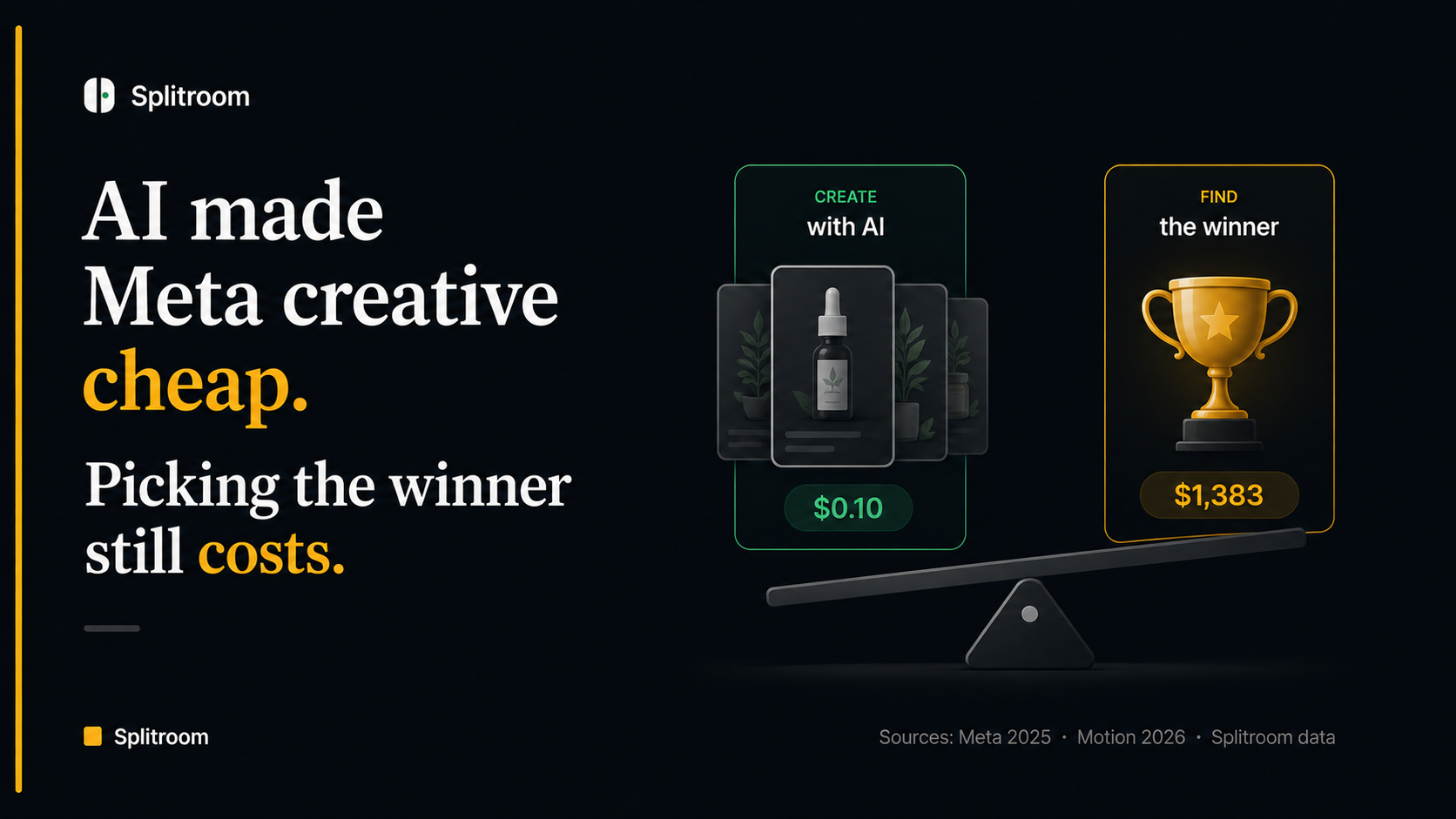
The unit cost of a Meta ad video collapsed from $2,700 to $1 between 2022 and 2026. Meta's 5% winner rate did not budge. Here is what shifted.
In 2022, a UGC video for Meta cost about $2,700 to produce.
That is not from memory. That is Statista's benchmark: video-based sponsored posts on TikTok averaged $2,102, YouTube $2,741, Instagram Stories $2,784.[3] One creator, one video, one Meta-ad-length asset. That was the industry norm.
And that number set the pace of media buying. Foxwell Digital's Meta creative framework from that era treated two to four new creatives per week as the expected output at $50,000 to $100,000 per month in ad spend.[2] Two weeks of production could exceed a month of media budget. That was the physical constraint on how fast a media buyer could iterate.
Fast forward to 2026.
The same 10-second Meta ad video costs $0.80 to produce on Google Veo 3 Fast.[4] Five dollars sixty on OpenAI Sora 2 Pro. Meta Advantage+ Creative bundles it into Ads Manager at zero incremental cost to the advertiser.[6] The top-quartile Enterprise Meta advertiser now ships 54.64 new creatives per week per Motion's 2026 benchmark.[1] That is fifteen to twenty-five times the 2022 pace, at roughly one-two-thousandth of the unit cost.
Meta's winner rate did not move. It is still about 5%.
Ship 54, 51 lose.
The bottleneck moved. It used to be making the ads. Now it is picking which of them to run.
Between 2022 and 2026, AI collapsed the unit cost of Meta creative production by roughly two orders of magnitude. But Meta's 5% winner rate is a property of the auction, not of any single creative. When everyone can produce more, everyone competes with more. The bottleneck in Meta advertising shifted. It used to be production (a UGC video cost $2,700 and took a week). Now it is judgment (a UGC video costs $0.80 and takes eight seconds, so which of your 54 weekly candidates deserves the $1,383 Meta test).
How production got cheap
The 2022 baseline. Statista's benchmark for video-based sponsored posts that year put the per-post cost at $2,100 to $2,800 across major platforms.[3] That was for one asset. Vidico's standing benchmark for commercial video production sat at $5,000 to $25,000 for standard shoots and $50,000 to $100,000 for high-end brand campaigns.[10] A media buyer sourcing UGC from a creator marketplace paid $2,000 to $3,000 per usable video. A media buyer commissioning a brand-quality spot paid ten times that.
Foxwell Digital's framework from the same era captured the physical consequence. At $25,000 to $50,000 per month in Meta ad spend, expected new creative output was one per week. At $50,000 to $100,000 per month, two to four per week. Only above $100,000 per month did the framework treat ten to fifteen new creatives per week as normal.[2] Production, not paid media, was the throttle.
Then generative AI closed the cost curve. Here is what a Meta-ad-length video creative costs in August 2026.
| Tool | Marginal cost per ad-length clip | Model / tier |
|---|---|---|
| Google Veo 3 Fast | ~$0.80 | $0.10/sec at 720p |
| OpenAI Sora 2 (API) | ~$0.80 | $0.10/sec at 720p |
| Runway Gen-4.5 | ~$2.30 | 12 credits/sec, Standard tier |
| Google Veo 3 (audio) | ~$3.20 | $0.40/sec |
| OpenAI Sora 2 Pro | ~$5.60 | $0.70/sec at 1080p |
| Meta Advantage+ Creative | $0 | Bundled into Ads Manager |
The unit cost of a Meta-ad-length video collapsed from $2,700 to under $1 in four years. That is not a marginal efficiency gain. That is two orders of magnitude. And it is not theoretical. It is showing up in the shipping data.
Motion's Creative Benchmarks 2026, drawn from 578,750 ads across 6,015 accounts and $1.29 billion in Meta spend, records enterprise-tier top-quartile weekly creative output at 54.64.[1]Cross-referenced against Foxwell's 2022 pre-AI framework of two to four creatives per week at similar spend brackets, that is a fifteen-to-twenty-five-times lift in top-of-funnel volume.
Production went from $2,700 per unit to $1 per unit. Volume went from two per week to fifty-four per week. And the media budget to test each new creative did not move.The cost curve, 2022 → 2026
Why Meta's winner rate did not move
The predictable response to a two-orders-of-magnitude cost collapse would be: winner rates rise, because every advertiser is now producing better creative faster. That is not what happened.
Meta's auction ranks ads relatively, not absolutely. It picks the creative most likely to earn the impression given every other creative competing for that impression at that moment. When production speed doubles industry-wide, every account's creative competes against every other account's creative at the new higher volume. The 5% winner rate is a distribution property of the auction, not of the creatives. It does not move because generation got cheaper. It only moves if the auction changes.
The adoption numbers back this up. Meta's own Q1 2026 earnings disclosed that 8 million advertisers were using at least one of Meta's AI creative tools, roughly doubling from 4 million at the end of Q4 2024.[7] The IAB State of Data 2026 put creative-process AI deployment at 83% of ad executives, up from 60% in 2024.[8] Every advertiser adopting AI production at the same time is exactly the condition under which winner rates stay flat. The auction rebalances at the new production tempo.
Which is a useful diagnostic. If your first thought was ‘so my AI-generated ads should be winning more,’ the correct update is: no, they should be losing at the same rate as everyone else's AI-generated ads. The individual advantage-of-cheaper-production is real. The industry advantage is not. The math of an efficient auction rules that out.
The bottleneck math
Now the specific numbers.
Motion's top-quartile Enterprise ship rate: 54.64 creatives per week.[1]
WordStream's 2025 aggregate US CPL on Meta: $27.66.[9] Meta's own Learning Phase threshold: roughly 50 optimization events per ad set. Cost to test one creative to that threshold: $1,383.
Multiplied out: 54.64 x $1,383 = $75,548 per week to Meta-test every creative you ship. That is $302,000 per month in test spend alone. That is a top-quartile Enterprise-tier monthly Meta budget applied entirely to Learning-Phase discovery, before a single dollar of scaled media.
Nobody does this. Nobody can afford to.
Which means the 54 candidates have to be filtered somewhere between production ($0.80) and Meta test ($1,383) before any of them enters the auction. That filter is the new bottleneck. It is not production. Production is solved. It is not attribution or measurement. Those are downstream. It is the pre-launch judgment call on which of the 54 deserves the $1,383 Meta test.
Production unit cost: ~$1. Meta test unit cost: ~$1,383. Between those two numbers sits an entire product category that did not need to exist in 2022 because nobody had 54 candidates to filter. In 2026, it is the highest-leverage tool in a Meta media buyer's stack.
Why the existing testing tools were built for the old world
PickFu, Marpipe, Poll the People, Kantar, Nielsen. All designed when the media buyer's problem was ‘I have three to five finalists, help me pick.’ Their unit economics were built for that regime. PickFu at $15 to $1,000 per poll made sense when you ran three polls per campaign. Total pre-launch test spend, under $5,000. Cheaper than Meta by an order of magnitude.
Now the media buyer has 54 candidates. If PickFu costs $150 per creative to test, filtering 54 candidates costs $8,100 per week. That is $34,000 per month. That is not cheaper than Meta. That is comparable to a Meta test budget. The economics do not scale to AI production speed.
The tools were designed for a different volume regime. Fine tool, wrong-shaped market.
Poll the People at $15 to $500 per poll runs into the same math. Marpipe at four-figure monthly enterprise pricing charges at the production-cost tier a decade ago. Kantar and Nielsen were never priced for individual-creative testing; they are built for annual brand studies. syntheticusers.com adjacencies at $99 to $199 per study are closer, but per-study, not per-creative-at-scale.
Every one of them is priced for a world where the media buyer had five finalists. In 2026, the media buyer has fifty candidates. The tools that assumed the old volume regime cannot serve the new one at the price point the new one requires.
What the new-bottleneck tool has to look like
Two constraints, both non-negotiable.
Unit economics of pre-launch judgment have to match unit economics of AI production. If a creative costs $1 to produce and $1,383 to Meta-test, the pre-launch filter has to price somewhere between those two numbers with meaningful headroom. Testing every creative at $150 does not work because it eats the ad budget. Testing at $1 to $2 per call works because it lands inside the production-cost regime.
Volume ceiling has to match production speed. A tool built to run three tests per campaign is not the same category as a tool built to run 50 to 100 filter calls per week. Different product architecture, different pricing model, different volume-of-calls guarantee. The gap is not incremental.
Solve for both: subscription pricing, high monthly call ceiling, pre-launch judgment at production-tier unit cost. That is the specific product category the bottleneck shift created.
What Splitroom looks like at that math
Solo tier: $19/month, 10 sims. Effective cost per pre-launch judgment call: $1.90.
Agency tier: $99/month, 50 sims. $1.98 per call.
Enterprise tier: unlimited runs at fixed monthly cost. Real-usage effective cost per call: cents.
Those numbers are not accidents. They are what the new-bottleneck economics demanded. Pre-launch judgment at the same unit cost as AI production is the specific category Splitroom occupies.
Static creatives specifically (see the companion piece ‘Meta's top-winning ad format is not video. It is text.’). Two go in. Up to a thousand synthetic buyers argue them out. Verdict, segment splits, dimension attribution in about nine minutes. Not ‘pick a winner from three finalists.’ Filter your 50 to 100 weekly candidates down to the three or four worth burning Meta spend on.
The old testing tools sold a compare-finalists workflow. That was the correct product for the old volume regime. The new-bottleneck tool sells a filter-candidates workflow. Different job. Different math.
The market moves. Tools follow.
For the first time in a decade, the pre-launch filter is the highest-leverage tool in a Meta media buyer's stack. Not production, which is solved. Not measurement, which is downstream of the auction. Not attribution, which is a scoreboard. The specific question of which of the 54 weekly candidates deserves the $1,383 Meta test is where marginal dollars now compound.
Every existing creative-testing tool priced above that math is going to have to reprice or disappear. The founders of those tools built for a real, correct 2018 problem. The problem moved. The tools have to move too, or new tools built inside the current bottleneck economics will take the market.
The old bottleneck was making the ads. That bottleneck is gone. AI killed it. Motion's data records the aftermath: 54.64 creatives per week at the top quartile, at $0.80 per creative unit cost, against a 5% winner rate that did not move.
The new bottleneck is picking which of them to run. That is the product Splitroom is built for. Priced for it. Volume-tiered for it. Category-locked for it.
Production got cheap. Judgment got expensive. The tools that recognize which bottleneck the market is actually solving get the decade.
Fair questions
What did a Meta ad video actually cost to produce in 2022?
Statista's industry benchmark for video-based sponsored posts in 2022 put the cost per creator post at about $2,102 on TikTok, $2,741 on YouTube, and $2,784 on Instagram Stories. Brand-level commercial shoots ran $5,000 to $25,000 for standard quality and up to $100,000 for high-end campaigns per Vidico's production benchmarks. So one UGC-style video from a marketplace creator was $2,000 to $3,000, and one brand-quality shoot was $10,000 or more. Foxwell Digital's pre-AI framework said a $50,000 per month Meta advertiser was expected to ship two to four new creatives per week. Two weeks of production could exceed a month of ad spend.
Are AI-generated Meta ads as good as human-produced ones?
In aggregate, yes, and Meta's own data supports it. Meta reported a 3% conversion-rate lift from advertisers using video-generation tools in its Q1 2026 earnings. Motion's Creative Benchmarks 2026 also shows the top-winning ad formats (text-only at 11.60% hit rate, product-image with text at 8.75%) are exactly what AI generates most reliably. UGC-style formats where authenticity is a signal (real creator faces, unpolished footage) still favor human creators in some verticals. But the average performance of AI-generated static and simple video creative now meets or exceeds the average of human-produced creative in the same format, at a fraction of the marginal cost.
How much does it actually cost to test one Meta ad to a decision?
About $1,383 in the United States, using WordStream's 2025 aggregate lead-generation CPL of $27.66. Meta's Learning Phase requires roughly 50 optimization events per ad set. 50 events x $27.66 = $1,383. That is the minimum to see whether one creative reaches Meta's own signal threshold. Real test budgets are higher once you account for buffer above the 50-event minimum, Learning Phase resets when you edit creatives, and multiple ad sets needed to reach a confident kill decision. For purchase-optimized campaigns, the per-creative test cost is often three to five times higher.
Why don't existing creative testing tools solve this?
Because they were built for a world where the media buyer had 3 to 5 finalists and needed to pick between them, not 54 candidates and needed to filter. PickFu at $15 to $1,000 per poll works for the 'which of these three do I run' question. It does not work for the 'which 3 of these 54 do I run' question, because 54 polls at $150 each is $8,100 per week. That is comparable to Meta ad test spend, not cheaper than it. Marpipe, Poll the People, and Kantar were designed for the same volume regime. When production speed changed, the tools priced for the old regime stopped fitting the math.
Which AI tools should I use to generate Meta ads?
Depends on the format and quality target. For 10-second Meta-ad videos, Google Veo 3 Fast at $0.10 to $0.12 per second is the cheapest cite-able tier, followed by OpenAI Sora 2 at $0.10 per second at 720p. For avatar-driven videos, HeyGen at $29 per month unlocks 30 minutes of premium avatar video. For static images at production quality, Midjourney at $10 to $30 per month is standard. Meta's own Advantage+ Creative video generation is bundled into Ads Manager at no additional cost. The category is competitive and pricing changes fast; use the current pricing page of each tool for procurement decisions, not this article.
Is the production-cost collapse permanent?
Yes, in direction. Unit cost curves in AI-generated media have moved one direction (down) since 2022 and continue to. What is less clear is whether the winner rate stays at 5% forever. If AI-generated creative gets meaningfully better at prediction (not just generation), Meta's auction dynamics could tighten and the winner rate could rise. More likely: everyone adopts AI production and the auction rebalances at similar winner rates against more competitive creatives. The bottleneck shifts, but it does not disappear. It moves to whatever is still expensive. In 2026, that is judgment.
Sources
- Creative Benchmarks 2026 (578,750 ads, 6,015 accounts, ~$1.29B Meta spend) · Motion · retrieved 2026-08-04
- Meta Ads: How Much Creative Is Needed by Volume · Foxwell Digital · retrieved 2026-08-04
- Average Cost of a Sponsored Influencer Post by Platform (2022) · Statista · retrieved 2026-08-04
- Gemini API pricing — Veo 3 video generation · Google · retrieved 2026-08-04
- Runway pricing (Gen-4.5 credits) · Runway ML · retrieved 2026-08-04
- Meta Advantage+ Creative · Meta for Business · retrieved 2026-08-04
- Meta Q1 2026: $56.3B revenue as AI tools double advertiser adoption · PPC Land (reporting Meta Q1 2026 earnings) · retrieved 2026-08-04
- IAB State of Data 2026: creative AI adoption (via Luma Labs) · IAB (aggregated by Luma Labs) · retrieved 2026-08-04
- Facebook Ads Benchmarks 2025 (US CPL $27.66) · WordStream · retrieved 2026-08-04
- Video Production Cost Benchmarks · Vidico · retrieved 2026-08-04
Your ad creatives go in, up to six at once. A thousand synthetic consumers argue it out, before a dollar of media moves.
Free in early access · No card required