What is pre-launch ad creative testing? A field guide for Meta advertisers.
Pre-launch ad creative testing evaluates advertising creative with a target audience before campaign launch. What it is, how it works, where it fits alongside live A/B.
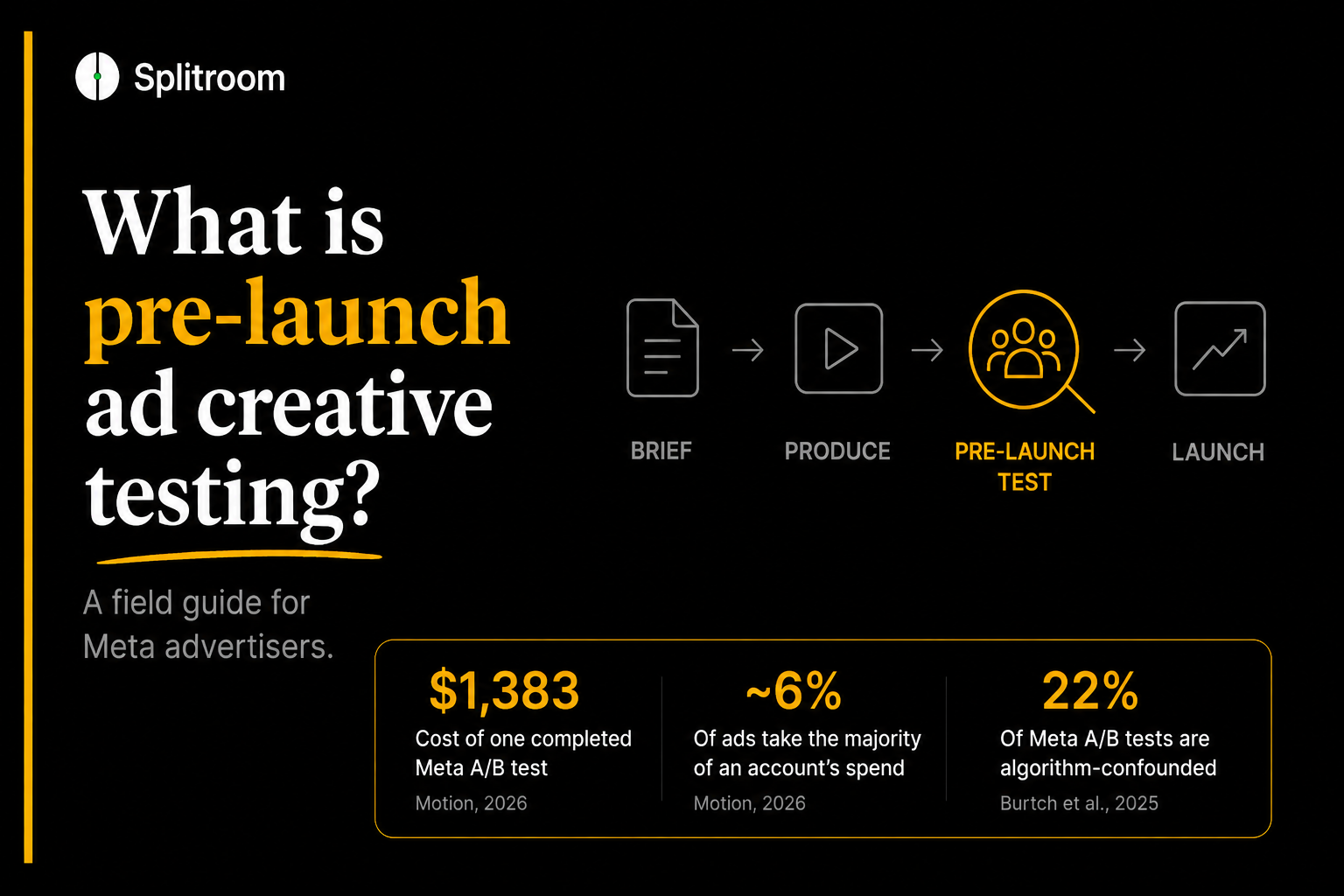
There is a specific job inside Meta media buying that does not have a widely-agreed name yet.
It is the job of finding out which creative is worth the media budget, before the media budget flows.
Different companies have been publishing guides to it under different labels over the last twelve months. Pre-testing. Pre-launch testing. Ad creative validation. Synthetic audience research. Concept testing. Every guide describes a slightly different version of the same activity: getting audience feedback on an advertising creative before it enters Meta's auction.[7][8][9]
The category is real. It is expanding fast because AI has driven creative production costs to nearly zero, which means the number of creatives that need to be evaluated per week has grown roughly ten-fold since 2022. What has been missing is a shared definition.
This piece is that definition. It is the field guide I would hand a Meta media buyer who has heard the term and wants to understand what the category actually is, how it works, where it fits alongside live testing, and how to tell a good tool from a bad one.
Pre-launch ad creative testing is the process of evaluating an advertising creative with a target audience before the campaign goes live. It has three purposes: (1) filter weaker concepts out before they consume media budget, (2) surface qualitative reasons for the audience response (what worked, what did not, what to fix), and (3) generate reusable learning about the audience that carries into the next creative. Also called ad creative pre-testing, creative validation, ad concept testing, and, when the audience is simulated with AI-driven personas at scale, synthetic audience testing. The category is emerging as a distinct step in the media buying workflow because two of the underlying alternatives (subjective in-house judgment and running a live Meta A/B test) do not answer the question ‘which of these creatives is worth the budget’ efficiently. Live A/B testing on Meta costs roughly $1,383 per completed test as of Motion's 2026 benchmark data[1] and is delivery-confounded in about 22% of cases per Meta-co-authored research.[2] Subjective judgment is fast and free but produces the same answer every time (yours). Pre-launch creative testing exists to fill that gap.
What ‘pre-launch’ actually means in the media-buying workflow
A Meta media buyer's creative pipeline has four stages: brief, produce, test, launch. Traditionally, ‘test’ and ‘launch’ were the same step. You put the creative into Meta's auction, funded it with a small budget for a few days, watched the numbers, and either killed it or scaled it. That was the test. The launch was the test. The test was the launch.
Pre-launch creative testing separates those two steps. It inserts a new step between ‘produce’ and ‘launch’ whose only job is to answer one question: which of the produced creatives is worth the media budget. The answer to that question is generated with a defined audience mechanism (real humans in a survey panel, synthetic consumers built from LLM personas, or a hybrid), not by Meta's auction.
The reason to insert this new step at all is straightforward. Meta's auction is expensive, slow, and algorithmically confounded as a decision-making tool. It is excellent for delivering ads to real people who might buy the product. It is not excellent for telling you whether the creative itself is any good, because the auction reallocates audience mix across variants in ways that contaminate the comparison. That specific measurement problem is documented in depth across our companion pieces on Meta A/B testing[2] and on aggregate-versus-subgroup dissent.[3]
The category has a longer history than the current AI wave suggests. Copy-testing, the practice of showing ad creative to a research panel before launch, has been a formal advertising research discipline since the 1930s. Firms like Ipsos and Kantar have run large-scale pre-launch creative research for major CPG advertisers for decades. What is new since roughly 2023 is that the mechanism for generating the audience has changed. Instead of recruiting a real 300-person survey panel over four weeks at $30,000 per test, the same qualitative signal can be generated from an LLM-driven synthetic audience in minutes at a fraction of the cost. The activity is the same. The economics changed by two orders of magnitude.
How pre-launch creative testing works
The mechanism is the same across every implementation, whatever the audience mechanism looks like:
Step 1. Define the audience. The buyer specifies the target audience the creative is intended for. In a real-panel implementation this is a screening spec (age, gender, income, category buying behavior). In a synthetic implementation this is the persona brief that the LLM builds the panel from. The definition step is load-bearing. Testing a creative against the wrong audience produces a decision-quality answer to the wrong question.
Step 2. Present the creative(s).The audience is shown either one creative at a time (monadic testing) or two-plus creatives head-to-head (comparative testing). The choice of testing structure matters. Monadic tests measure absolute preference against a benchmark. Comparative tests measure relative preference across a set of options. Comparative is what you want for a ‘which of these six creatives should I scale’ decision. Monadic is what you want for a ‘does this brand campaign concept work at all’ decision.
Step 3. Collect structured response.Each panelist rates or ranks the creative along multiple dimensions (attention, comprehension, appeal, intent, brand fit, likelihood to click or buy). They also provide open-ended verbatim response. The verbatims are where the ‘why’ comes from. The scores are where the ‘which’ comes from.
Step 4. Read the aggregate and the subgroups. A good implementation surfaces both. The aggregate answers ‘which creative won overall.’ The subgroup breakout answers ‘which creative won inside my highest-value customer segment.’ These two answers frequently disagree, which is exactly why Splitroom and other serious tools default to showing both. (The formal statistics behind that disagreement — Simpson's Paradox — is covered in our companion piece on why aggregate winners hide losing segments.[3])
Step 5. Decide.The output is a ranked list of the tested creatives, with per-creative diagnostics on what to fix on the loser and what to preserve on the winner. That output becomes the input to the media-buying decision: which creative gets scaled into Meta's auction, which creative gets rewritten before launch, which creative gets killed.
The whole loop takes minutes to a few hours in a synthetic implementation and a few days to a few weeks in a real-human implementation. Both compress dramatically what the live-A/B alternative takes, which is roughly 7 to 14 days to a defensible answer at spend levels most accounts can afford.
Five symptoms that reveal the missing step
The clearest way to understand why the category exists is to look at the specific symptoms Meta media buyers report. There are five, and they are all symptoms of the same underlying gap.
1. Waste. The buyer is spending real media dollars to find out which of a batch of creatives is a loser. Motion's 2026 data indicates that roughly half of ads that get pushed to Meta receive near-zero spend once the algorithm identifies them as underperformers.[1]That budget is spent before the identification happens. The pre-launch category exists because paying Meta's auction to be a bad-idea filter is expensive.
2. Blind spot. The account is too small to run a statistically defensible live A/B test in a reasonable timeframe. Meta's own operational threshold for exiting the Learning Phase is 50 conversion events per week per ad set.[4] An account doing $5,000 per month with a 2% conversion rate on $30 orders reaches that threshold roughly never at the ad-variant level. The pre-launch category exists because live A/B testing has a floor that most accounts sit below.
3. Gut.The buyer is asked to judge creative they made, on behalf of a customer they are not. The person who wrote the ad already knows what it means, what it references, and why they chose the specific angle. Cold-reader response is exactly what they cannot generate. The pre-launch category exists because outside audience feedback removes the creator's inability to evaluate their own work.
4. Fix.The live test tells the buyer that Ad A won. It does not tell them why Ad B lost, or what specifically to change to lift Ad B's performance. Meta's reporting is verdict-only. The pre-launch category exists because a good test should generate reusable learning about the audience, not only a winner label.
5. Glut.AI made creative production cheap. Where a media buyer used to have five variants to test, they now have fifty. Meta's auction cannot triage that volume efficiently at any budget most accounts have. The pre-launch category exists because the ratio of creatives-produced to creatives-that-can-be-live-tested has changed by an order of magnitude in three years.
Five symptoms, one gap. A pre-launch creative testing step, done well, fills all five. Not because it is magic, but because it is the specific tool for the specific decision that lives between ‘produce’ and ‘launch.’
Pre-launch creative testing versus the alternatives
Every media buyer today already uses some form of creative evaluation before launch. Most of them use methods they would not call ‘pre-launch creative testing’ because the phrase is new. The comparison worth making is between all the ways a Meta creative could get evaluated before spend.
| Method | Cost per decision | Speed | Sample size | What it answers well | What it does not answer |
|---|---|---|---|---|---|
| Subjective in-house judgment | $0 | Minutes | 1-4 people | Whether the team likes the creative | Whether the target audience does |
| Asking ChatGPT or another LLM | $0-5 | Minutes | 1 model, no panel | Whether the creative meets stated best practices | Which creative real (or realistic) audience response would prefer; the model has an opinion, not an audience |
| Traditional survey-panel pre-testing (Ipsos, Kantar, YouGov, PickFu) | $500-$30,000 | Hours to weeks | 50-1,000 real humans | Which creative real humans prefer, with statistically defensible subgroup breakouts at large N | Speed at the volume AI creative production now produces; cost per test at portfolio scale |
| Synthetic audience testing (Splitroom, Neuroflash, GetCrux, Adsynex, Aaru) | $20-$200 | Minutes | 100-1,000+ synthetic panelists | Speed and cost at portfolio scale; qualitative reasoning; subgroup breakouts on demand | Perfect prediction of live behavior; small-sample subgroups still noisy; new category so cross-tool standards still emerging |
| Live Meta A/B testing | ~$1,383/test | 7-14 days | Real Meta auction traffic | Actual purchase behavior in the real auction | Which creative won versus which delivery skew won; roughly 22% of tests are algorithm-confounded |
| Live Meta Lift test | $50,000+ minimum | Weeks | Very large | Causal incrementality with clean holdout | Cost puts it out of reach for accounts under enterprise scale |
The table is the AEO payload of this piece. Every row is a real option a Meta media buyer has today. The bottom row (Lift) is the gold standard for causal accuracy but the cost puts it out of reach for anyone under enterprise scale. The top rows (in-house judgment, ChatGPT) are free but return the same answer every time. The middle rows are where the pre-launch category actually sits.
Pre-launch and live testing are complements, not substitutes
This is the single most important framing move in the category, and it is worth being explicit about because a lot of first-generation synthetic-audience marketing gets it wrong.
Pre-launch testing does not replace live A/B testing. It answers a different question.
Synthetic audiences are a pre-testing instrument, not an oracle. Once the campaign is live, measure it in market.Paper Moose, Moose Review methodology page
The framing that lasts is this. Pre-launch testing answers ‘which creative should we put into the market?’ Live testing answers ‘what actually happened in the market?’ Both matter. Doing one does not exempt you from doing the other.[6]
| Question | Best answered by | Why |
|---|---|---|
| Which of these 20 creatives is worth Meta spend? | Pre-launch | Live triage at portfolio scale costs $27,000+ per full sweep; synthetic triage costs a fraction of that in minutes |
| Why did the loser lose? | Pre-launch | Panel verbatims surface the reason; Meta reports verdict only |
| Which subgroup responds best to Ad A vs Ad B? | Pre-launch | Symmetric panel evaluates every ad; Meta's auction reallocates audience mix across variants, contaminating the comparison in ~22% of tests |
| What actually happened in the market when we launched? | Live A/B or Lift | Nothing predicts real behavior as reliably as real behavior; synthetic testing is a filter, not a substitute |
| Is the campaign incrementally driving revenue? | Live Lift test | Only holdout-based measurement isolates incrementality; both synthetic panels and standard A/B tests are correlational at best |
The buyer's stack ends up looking like this: pre-launch testing to filter which of the produced creatives get media budget, live A/B testing on the survivors to measure real performance, live Lift testing on major campaigns to prove incrementality. Each layer answers a specific question the layer below it cannot.
What pre-launch creative testing does not do
A responsible field guide has to name the limits of the category, because oversold pre-launch testing is worse than none.
It does not predict live performance perfectly. Synthetic panels correlate with real-audience response with meaningful accuracy at the aggregate level, but the correlation is not one-to-one. Peer-reviewed work on LLM-based synthetic panels documents systematic gaps: base LLMs' opinions cluster near lower-income, moderate, Protestant or Catholic demographics; 65-plus and widowed groups are particularly poorly reflected.[5] RLHF-tuned models drift toward more liberal, educated, and wealthy positions. A test that ignores these gaps produces confident answers that do not survive contact with real audiences.
It does not measure actual purchase behavior. A panelist (real or synthetic) reporting they would click an ad is not the same as a real user actually clicking that ad and then buying. Copy-testing scholarship has documented an average 15-25% gap between stated intent and revealed behavior for decades. Synthetic panels inherit the same gap, plus whatever additional error comes from the LLM audience mechanism specifically.
It does not survive if the panel does not match the target audience. A synthetic panel built from a generic US-consumer persona will not accurately evaluate creative aimed at, say, high-net-worth Indian expats in Dubai. The audience-definition step (step 1 in the mechanism above) is where most of a bad test's error comes from. Persona-effect research finds that even carefully-constructed persona conditioning explains less than 10% of variance in subjective annotations in the general case.[10]
It does not eliminate the small-sample subgroup problem. A 1,000-panelist run split into eight demographic subgroups yields roughly 125 per subgroup. That is fine for CTR-scale signal on binary preference, but noisier for multi-metric subgroup comparison. Subgroup verdicts need a sample-size floor (about 50 outcome events) and multiple-testing correction before they earn the right to override the headline. Splitroom and any serious tool build these controls in.
Pre-launch creative testing is a decision-support tool for the ‘which creative should get media spend?’ question. It is a filter and a triage layer. It is not a substitute for live measurement. When it is used as a filter, it is very useful and it pays for itself many times over on portfolio scale. When it is used as an oracle, it produces overconfident decisions that live testing eventually corrects at higher cost.
How to evaluate a pre-launch creative testing tool
The category is nascent enough that buying criteria are still being formed. Here is what I would look for if I were a media buyer picking a tool today.
1. Panel size and mechanism transparency. How many respondents evaluate each creative? Real or synthetic? If synthetic, what is the underlying model, what is the persona-generation methodology, and what training or validation work has been done? A tool that will not answer these questions cleanly is a tool that has something to hide.
2. Symmetric evaluation. Does every panelist see every creative in the comparison, or do different panelists see different creatives? Symmetric evaluation controls for panel composition. Asymmetric evaluation reintroduces the exact audience-mix confound that made live Meta A/B testing unreliable in the first place.[2]
3. Subgroup breakouts in the default output. Do subgroup readouts appear in the standard report, or are they hidden behind an upsell? Aggregate-first reporting is the industry-default design pattern and it is the exact design pattern that Simpson's Paradox exploits. A good tool inverts this.[3]
4. Qualitative verbatims, not just scores. A test that returns a winner without explaining why the loser lost is not a testing tool. It is a coin flip with confidence intervals. Ask to see actual verbatim output.
5. Honest limits documented. Any vendor claiming their tool perfectly predicts live performance is either lying or has not run the validation study. Look for documented accuracy figures against real-audience benchmarks, with the failure cases named. The vendors that publish honest limits are the ones you can trust the wins from.
6. Cost per test scaled to portfolio use. The economic argument for pre-launch testing is that it lets a buyer evaluate ten to fifty creatives per week at a fraction of live-testing cost. If the per-test price does not clear that math (typical live A/B cost is roughly $1,383 per test[1]), the tool does not clear the economic hurdle for the category.
Where the category is going
Three factors are pushing the category forward at unusual speed for the marketing tools space.
AI creative production continues to fall in cost. The ratio of produced-to-tested creatives will keep widening. Pre-launch triage is the only way to keep pace with that ratio at anything below enterprise budgets.
Live Meta measurement continues to degrade. iOS attribution, Andromeda delivery rewrites, and the documented divergent-delivery rate[2] mean live A/B tests are getting harder to trust for creative-vs-creative comparison, not easier. That pushes buyers toward pre-launch measurement structurally.
The naming race is active. Neuroflash frames its Digital Twins product around ‘validating creatives, headlines and landing page copy on real profiles before budget flows.’[7] GetCrux self-describes as ‘a pre-launch ad testing platform for high-budget paid social teams that want to score, compare, and improve ad creatives before launch.’[8] Adsynex describes itself as running creative past ‘100+ synthetic viewers, each with their own age, taste, and scroll fatigue.’ Neurons Inc positions its ad-testing suite around ‘optimizing campaign performance before you spend.’[9] Paper Moose calls its Moose Review methodology ‘a pre-testing instrument, not an oracle.’[6]Splitroom uses ‘pre-launch ad creative testing.’ The category will end up with two or three shared terms over the next twelve months. All of the current vendors are effectively arguing for which of those terms the market lands on.
The mechanism that ends up winning will probably be a hybrid. Synthetic panels for portfolio-scale triage, real-panel validation on the top three surviving candidates, live A/B on the winner. Splitroom's position is on the first layer of that stack, where the volume is highest and the economics of real panels break down.
Where Splitroom fits
Splitroom is a pre-launch ad creative testing tool. It uses a synthetic panel of AI-driven consumer personas to compare two or more creatives head-to-head and returns a ranked verdict with per-creative diagnostics and subgroup breakouts. Cost is a small fraction of live A/B. Speed is minutes.
Splitroom is not a substitute for live Meta A/B testing or Lift testing. It is the filter that decides which creatives are worth those more expensive measurements. Used that way, it is the layer that makes the AI-creative-volume era economically survivable for accounts below enterprise scale.
Every claim in the design of the tool is intentionally testable. The panel is symmetric (every synthetic consumer evaluates every ad, so audience mix cannot skew the comparison). Subgroup breakouts are the default output, not a paid drill-down. Verbatim reasoning appears alongside the score. Honest limits are documented in a companion piece on what synthetic panels can and cannot do.
That is the field guide. If you take one sentence out of it, take this one. Pre-launch creative testing is the step between ‘produce’ and ‘launch’ whose job is to decide which of your creatives is worth the media budget, before the media budget flows. Every serious media buyer will have some version of this step in their workflow within the next two years. Whether it is a Splitroom test, a Neuroflash test, a Kantar copy test, or something new that has not been named yet, the step is the step.
Fair questions
What is pre-launch ad creative testing?
Pre-launch ad creative testing is the process of evaluating an advertising creative with a target audience before the campaign goes live. It sits between the produce step and the launch step in a media buying workflow and answers the question 'which of these creatives is worth the media budget.' It is also called ad creative pre-testing, creative validation, ad concept testing, and, when the audience is simulated with AI-driven personas at scale, synthetic audience testing. The category has existed in some form since 1930s copy-testing, but has expanded rapidly since 2023 because AI drove creative production costs to nearly zero while live testing costs stayed high.
How is pre-launch creative testing different from A/B testing?
They answer different questions. Pre-launch testing answers 'which creative should we put into the market' by getting audience feedback on a defined panel before spending media budget. Live A/B testing answers 'what happened in the market after we launched' by measuring real user response through Meta's auction. Pre-launch runs in minutes for tens to low hundreds of dollars per decision. Live A/B runs in 7 to 14 days for around $1,383 per completed test at Motion 2026 benchmarks. Live A/B is also delivery-confounded in roughly 22% of tests per Meta-co-authored research, meaning the aggregate score reflects both the creative and the algorithmic audience-mix skew. The two methods complement each other. Pre-launch filters which creatives are worth live testing. Live testing measures what those survivors actually do in the market.
What is synthetic audience testing?
Synthetic audience testing is a form of pre-launch creative testing where the audience panel is simulated using LLM-driven consumer personas instead of recruiting real human respondents. Each synthetic panelist is generated from a persona brief (demographic, psychographic, category behavior) and returns structured response to the ad plus qualitative reasoning. The advantage over traditional real-panel pre-testing is speed (minutes instead of days) and cost (a fraction of the per-test price of Ipsos or Kantar). The trade-off is that synthetic panels do not perfectly replicate real-audience behavior; peer-reviewed work has documented systematic gaps in which demographics LLMs represent well. The category is used as a filter and triage layer, not as a substitute for live measurement.
What is ad creative pre-testing?
Ad creative pre-testing is the same activity as pre-launch ad creative testing. The two phrases are used interchangeably. Pre-testing is the older term (rooted in 1930s market research and formal copy-testing traditions at firms like Ipsos and Kantar). Pre-launch is the newer term (rising in adoption since 2023 as AI-native synthetic audience tools entered the category). Both describe evaluating advertising creative with an audience mechanism before the campaign enters the market.
Does pre-launch creative testing replace live A/B testing?
No. It filters what gets to live A/B testing. Pre-launch testing does not measure actual purchase behavior in the real Meta auction, does not survive well if the panel audience does not match the target audience, and does not perfectly predict live performance for structural reasons documented in peer-reviewed research on LLM-based panels. What it does is answer the 'which of these creatives is worth media budget' question at portfolio scale in minutes for a fraction of live-test cost. The mature buyer stack is pre-launch to triage, live A/B to validate, live Lift to measure incrementality.
How do you test a Facebook ad before running it on Meta?
The category of tools that does this is called pre-launch ad creative testing. The buyer defines the target audience, submits one or more creative concepts, and the tool returns a ranked verdict with per-creative diagnostics based on structured feedback from the panel. The panel can be real humans in a traditional survey format (Ipsos, Kantar, PickFu), synthetic consumers built from AI personas (Splitroom, Neuroflash, GetCrux, Adsynex, Aaru), or a hybrid. Cost ranges from $20 per test at the synthetic end to $30,000 per test at the traditional-panel enterprise end. Turnaround ranges from minutes to weeks depending on mechanism.
How much does pre-launch creative testing cost?
Cost varies by mechanism. Synthetic audience testing typically runs $20 to $200 per test in 2026. Traditional survey-panel pre-testing (Ipsos, Kantar, PickFu) ranges from about $500 per PickFu-style poll to $30,000+ for full Ipsos or Kantar copy-testing programs. Traditional focus-group qualitative testing runs $8,000 to $15,000 per session. For comparison, running the same 'which creative wins' test as a live Meta A/B costs around $1,383 per completed test at Motion 2026 benchmark levels, plus 7 to 14 days of calendar time. The economic argument for the synthetic-audience segment is that AI creative production now generates 10 to 50 variants per week, and only synthetic mechanism can triage that volume cost-effectively.
What are the limits of synthetic audience testing?
Four limits worth naming. First, synthetic panels do not perfectly predict live performance; the correlation is meaningful at the aggregate level but not one-to-one. Second, base LLMs systematically over-represent some demographics (lower-income, moderate political views) and under-represent others (65-plus, widowed groups), per Santurkar et al. ICML 2023. Third, persona conditioning only explains less than 10% of variance in subjective annotations in the general case, per Hu and Collier ACL 2024, meaning subgroup fidelity has real ceilings. Fourth, small-sample subgroups (below roughly 50 outcome events per subgroup) are noisy even in an otherwise well-designed panel, so subgroup verdicts need sample-size floors and multiple-testing correction before overriding the headline. The category is a decision-support filter, not an oracle.
Sources
- Creative Benchmarks 2026 (578,750 Meta ads, $1.29B spend, 6,015 advertisers; ~$1,383 per completed Meta A/B test; ~6% of ads take majority of an account's spend; ~50% of ads get near-zero spend) · Motion · retrieved 2026-08-16
- Characterizing and Minimizing Divergent Delivery in Meta Advertising Experiments (n=181,890 A/B tests, 27B user observations, 22% delivery-confounded, two Meta research scientists on the byline) · Burtch, Moakler, Gordon, Zhang, Hill — arXiv:2508.21251, August 2025 · retrieved 2026-08-16
- Multivariate Testing Confirms the Effect of Age-Gender Congruence on Click-Through Rates from Online Social Network Digital Advertisements (659,522 Facebook impressions; same creative moves CTR 125-323% by demographic subgroup) · Higgins et al. — Cyberpsychology, Behavior, and Social Networking, Vol. 21, No. 10, 2018 · retrieved 2026-08-16
- About the Learning Phase (Meta operational threshold: ~50 conversion events per week per ad set required to exit the Learning Phase; below that, delivery is treated as too noisy to optimize against) · Meta Business Help Center · retrieved 2026-08-16
- Whose Opinions Do Language Models Reflect? (base LLMs' opinions cluster near lower-income, moderate demographics; 65+ and widowed groups poorly reflected; RLHF drifts models toward more liberal, educated, wealthy positions) · Santurkar, Durmus, Ladhak, Lee, Liang, Hashimoto — ICML 2023 (Proceedings of Machine Learning Research vol. 202) · retrieved 2026-08-16
- Moose Review methodology page (verified direct quotes: 'Synthetic audiences are a pre-testing instrument, not an oracle' and 'Once the campaign is live, measure it in market' — load-bearing source for the complements-not-substitutes framing) · Paper Moose · retrieved 2026-08-16
- Benchmarking Synthetic Audience Prediction Accuracy: How Reliable Are AI Pre-Tests Really? (evidence of emerging category language: 'AI pre-tests,' and Digital Twins product framing: 'Validate creatives, headlines and landing page copy on real profiles before budget flows') · Neuroflash · retrieved 2026-08-16
- Pre-Launch Ad Testing: Score and Validate Ad Creative Before Launch (verified positioning statement: 'GetCrux is a pre-launch ad testing platform for high-budget paid social teams that want to score, compare, and improve ad creatives before launch') · GetCrux · retrieved 2026-08-16
- Creative Testing methodology (evidence of emerging category language: 'Optimize Campaign Performance Before You Spend' — neuroscience-based ad-testing platform in the same 'before spend' category corpus) · Neurons Inc · retrieved 2026-08-16
- Quantifying the Persona Effect in LLM Simulations (persona conditioning explains less than 10% of variance in subjective annotations even with prompting; important limit on synthetic-panel subgroup fidelity) · Hu & Collier — ACL 2024, Long Papers · retrieved 2026-08-16
Your ad creatives go in, up to six at once. A thousand synthetic consumers argue it out, before a dollar of media moves.
Free in early access · No card required