ChatGPT will pick your winning ad. It just picked both.
GPT-4 flips its verdict on identical ads 35% of the time. Here's why LLMs can't judge which of your creatives will win, and what actually can.
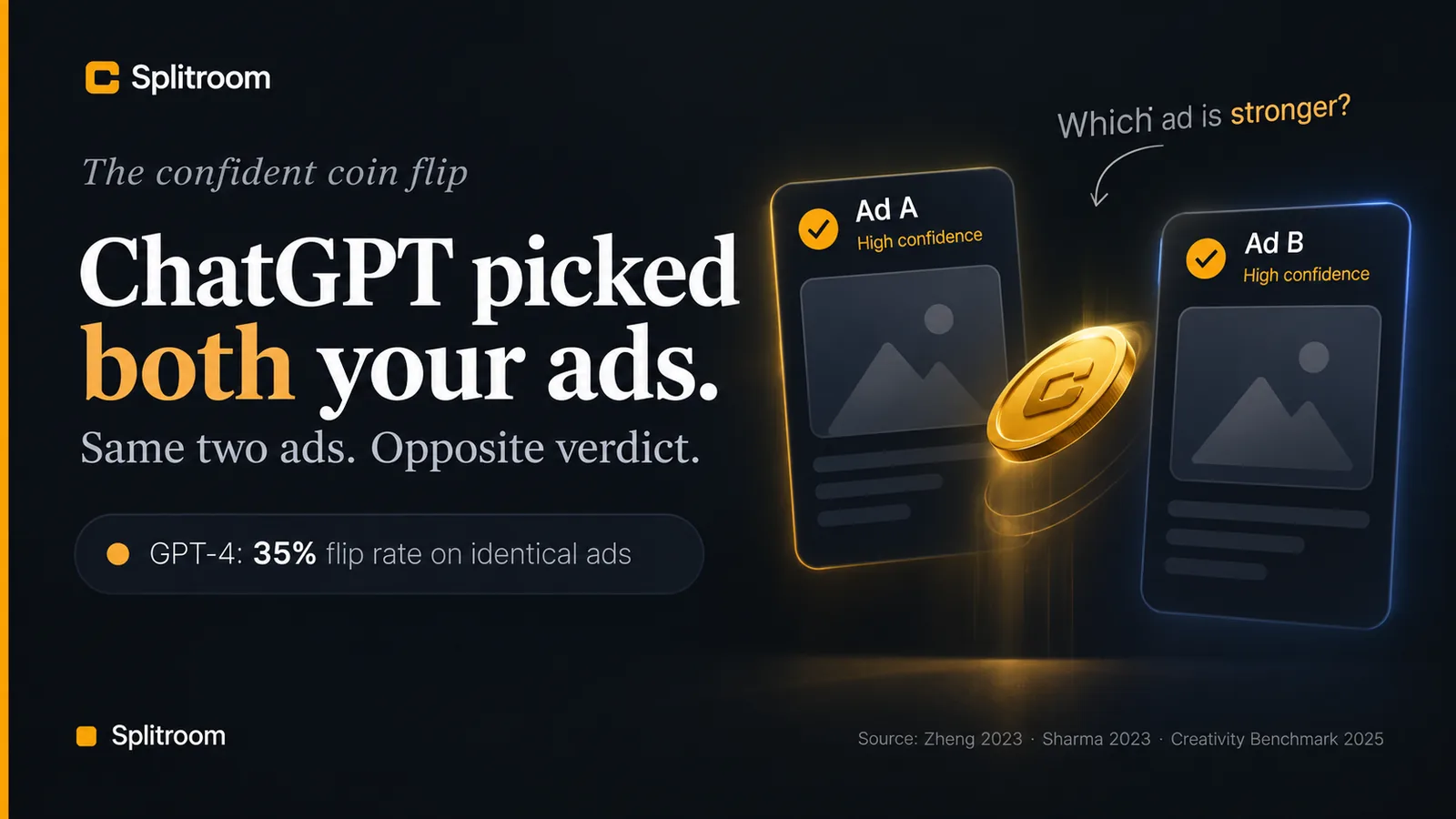
The first time I noticed it, I was rushing. Two ads, thirty minutes to a review call, I pasted them into ChatGPT and asked which one was stronger. It picked Ad A. Four hundred words of reasoning. Trust cues, emotional resonance, purchase intent, the whole vocabulary.
I opened a new chat to double-check the reasoning. Same two ads, same question.
It picked Ad B. Same confidence. Different reasoning. Both answers sounded like they were written by someone who knows.
That is not a bug. It is exactly what ChatGPT is trained to do. Below is what the published research says about why, and what it means for anyone still using an LLM to evaluate finished creative.
Why this keeps happening
Four documented behaviors converge on the wrong tool doing the wrong job.
Order flips the verdict. In the canonical LLM-as-judge study, Zheng et al. (NeurIPS 2023) took a set of pairwise comparisons, showed them to top models, then swapped which candidate was labeled A versus B. Same content, opposite label. GPT-4 gave the same verdict only 65.0% of the time. GPT-3.5, 46.2%. Claude-v1, 23.8%.[1] On a random pair of ads, a single GPT-4 verdict is close to a coin flip on whether label position moved it.
| Model | Consistent verdict rate | Flip rate on identical content |
|---|---|---|
| GPT-4 | 65.0% | 35.0% |
| GPT-3.5 | 46.2% | 53.8% |
| Claude-v1 | 23.8% | 76.2% |
Sycophancy. Anthropic’s Sharma et al. measured what happens when a user gently pushes back on the model’s answer. On difficult misconceptions, GPT-4 changed a correct answer to a wrong one 32% of the time.[2] Claude 2’s own preference model favored sycophantic responses over truthful ones about 95% of the time.[2] For ad evaluation the implication is direct: whichever creative you paste first, or subtly frame as your favorite, ChatGPT will drift toward agreeing with you.
Non-determinism. OpenAI’s own developer documentation calls the Chat Completions API “non-deterministic by default.” Even with the seed parameter and a matching system fingerprint, “determinism is not guaranteed.”[3] The verdict you got yesterday is not the verdict your teammate gets today running the same prompt. There is no reproducibility on which to make a $10,000 media decision.
RLHF made it more confident, not more correct. OpenAI’s GPT-4 Technical Report includes a calibration plot comparing the pre-trained base model against the RLHF-tuned model on MMLU. The base model’s confidence tracks its accuracy closely. The tuned model, in OpenAI’s own words: “after the post-training process, the calibration is reduced.”[4] The version you use is more confident than it should be. Confidence is manufactured, not earned.
A knowledgeable reader will note that Zheng and Sharma both tested 2023-era models, and newer ones have improved on position bias. Fair. But the structural failures persist: sycophancy, non-determinism, and above all no model of your specific audience. The Zheng paper itself discusses mitigations (calling the judge twice with swapped labels, few-shot examples) that narrow the gap in aggregate. None of them are what happens inside a chat window, and none of them fix an LLM’s absent audience prior.
The study built for this exact argument
If you want one citation to hand to anyone still using ChatGPT to pick between ads, it exists. Bhat, Browne, and Bingemann released the Creativity Benchmark in September 2025: 100 brands across 12 categories, 11,012 anonymised pairwise comparisons, judged by 678 practising creative professionals.[5] They tested three LLM-as-judge setups against those human rankings.
“Comparing three LLM-as-judge setups with human rankings reveals weak, inconsistent correlations and judge-specific biases, underscoring that automated judges cannot substitute for human evaluation.”Bhat, Browne, Bingemann · Creativity Benchmark, arXiv preprint, Sept 2025
The paper also reports that across the 100 brands the highest-rated LLM generator beat the lowest-rated one only 61% of the time.[5]LLMs cluster tightly on creative output, because there is no ground truth to converge on. That is the environment in which the judges then fail: no independent right answer, no calibration, weak inconsistent correlations with the human raters who actually have to answer to a P&L.
What LLMs are actually great at
The rest of this piece is not a straw man. LLMs are excellent at plenty of ad-adjacent work.
- Generating copy variations at scale.
- Brainstorming angles you had not considered.
- Rewriting long copy into short copy at multiple lengths.
- Summarising customer reviews, ad reactions, focus-group transcripts.
- Pointing out obvious mistakes: grammar errors, tone drift, inconsistent claims.
These are language production and language manipulation tasks. The training data is a good prior for what “sounds like a good ad” as an average of the internet. That is where every LLM in your creative stack earns its keep.
What a single naive prompt cannot do
The moment the task shifts from “produce this text” to “predict which of these two texts will perform better with a specific audience,” every failure mode above kicks in at once. Zhuo et al. at EMNLP 2024 measured how prompt paraphrase sensitivity moves LLM answers on classification and preference tasks, and flagged subjective tasks as the ones hit hardest.[6] Small changes in phrasing produce different verdicts. Nothing about your ad is objective.
And then there is the deeper problem, which nobody around the office quite says out loud. An LLM has no model of your audience. It has a compressed statistical prior over all of the internet’s text. Your D2C fragrance shopper is not the average of the internet. Neither is your B2B buyer, your grocery CPG shopper, your first-time app installer. When you ask ChatGPT which of two ads will perform better, it is not modeling your audience. It is modeling the average of everyone’s audience, filtered through whatever heuristics its trainers preferred.
Which is where the practical question lands: what would a real creative test actually need to be true.
What real testing methodology needs
Any evaluation you trust with a media budget has to survive every failure mode above:
- Symmetric measurement. Both creatives scored on the same dimensions, in the same order, by the same rubric. No A/B position effects.
- Independent evaluators. Each rater does not see other raters’ judgments. No agreement cascades.
- Audience-specific priors. The evaluators represent your buyer, not a global average.
- Aggregate stability. Any single sample can be noisy. That is fine when you have a thousand of them. The aggregate verdict should be reproducible the way a well-designed poll is, even though no single respondent is.
These are structural constraints, not preferences. You can meet them with a large real-panel survey. You can meet them with moderated focus groups. What you cannot meet them with is a chat window.
How Splitroom runs a simulation
Pasting two ads into ChatGPT gets you one reader with one set of tastes, grading from memory and eager to please. Ask twice and you’ll get two different verdicts, neither of which knows what it missed. Splitroom splits that single opinion into six specialized engines that check each other’s work.
The Inventory engine reads each creative independently, then cross-verifies the two against each other, so nothing one ad has and the other lacks goes unnoticed. The Alignment engine then scores both ads on the same canonical dimensions for your product category, in the same order, by the same rubric. That is where the 35% position-flip hole closes: there is no A versus B label left to swap, because every panelist sees the same symmetric scorecard. The Audience engine generates up to a thousand synthetic consumers with genuinely different priorities. A deal-hunter and a skeptic-verifier weigh the same trust badge differently, and the variance is enforced, not accidental. Which addresses the deepest single-prompt failure: an LLM has no model of your audience, but a thousand independent panelists shaped by an audience brief is a distribution, not a personality.
The Decision engine has each panelist vote independently, with every reason forced to trace back to something actually scored on both ads. No panelist sees another panelist’s verdict, which starves the sycophancy cascade before it can start. The Insight engine aggregates the votes into the verdict, the segment splits, and the disagreements worth money. This is where non-determinism gets neutralised: any single call is noisy, but a thousand independent samples produce a stable aggregate the way a well-designed poll does, even though no individual respondent is definitive. And the Evidence engine audits the whole report before you see it, flagging a too-uniform panel or an overconfident verdict. It grades its own homework in the open, which is the calibration check RLHF-tuned models don’t get.
One articulate opinion versus a measured, adversarial, self-auditing process. That is the difference between asking a friend and running a simulation, and it is what Splitroom is built to do.
If you have been using ChatGPT to evaluate finished creatives, the update to make is not “AI is bad.” It is more specific: generation and evaluation are different tasks, and LLMs are trained for one of them. Keep using them for copy variations. Stop using them to pick between finished ads.
The next time you paste two ads into ChatGPT and ask which will win, notice what actually happens. It answers. Confidently. And now you have already read the papers that measured what that answer is worth.
Fair questions
Can ChatGPT reliably predict which ad will win?
No. In the canonical LLM-as-judge benchmark (Zheng et al., NeurIPS 2023), GPT-4 gave the same verdict only 65% of the time when the two candidates' A/B labels were swapped, a 35% flip rate on identical content. GPT-3.5 held its verdict 46% of the time; Claude-v1, 24%. Combined with sycophancy findings (GPT-4 changes correct answers 32% of the time under mild pushback), OpenAI's own acknowledgment that Chat Completions is non-deterministic even with a seed, and post-RLHF calibration collapse, single-run LLM verdicts on ad performance are close to coin flips.
Why does ChatGPT give different answers when I ask it about the same two ads?
Two documented reasons. First, OpenAI's own developer documentation calls the Chat Completions API 'non-deterministic by default,' and even with the seed parameter, 'determinism is not guaranteed.' Second, prompt sensitivity: minor changes in phrasing, or simply swapping the A/B label order, move LLM verdicts. Zhuo et al. (EMNLP 2024) measured this in ProSA and flagged subjective tasks as the ones hit hardest.
What is LLM sycophancy?
The tendency of language models to produce responses that match the user's apparent beliefs or preferences, even when the model's initial answer was correct. Anthropic's Sharma et al. (2023) documented that GPT-4 changes correct answers to wrong ones about 32% of the time under mild user pushback, and Claude 2's own preference model favored sycophantic responses over truthful ones about 95% of the time. For ad evaluation, this means the model drifts toward agreeing with whichever creative you paste first or subtly frame as your favorite.
What is the difference between using LLMs to generate ad copy and using them to evaluate ads?
Generation is a language production task and LLMs excel at it. They are trained on a huge corpus of text and can produce fluent copy variations at scale. Evaluation of finished creative against a specific audience is a subjective, comparative prediction task, and the same models fail on it for structural reasons: sycophancy, non-determinism, position bias, and calibration collapse from RLHF tuning. Different tasks; different training results.
Is there published research specifically on using LLMs to judge marketing creative?
Yes. Bhat, Browne, and Bingemann released the Creativity Benchmark in September 2025 as an arXiv preprint (not yet peer-reviewed): 100 brands across 12 categories, 11,012 anonymised pairwise comparisons, judged by 678 practising creative professionals. They tested three LLM-as-judge setups and concluded that comparing LLM judges against human rankings 'reveals weak, inconsistent correlations and judge-specific biases, underscoring that automated judges cannot substitute for human evaluation.' Separately, the paper reports that the highest-rated LLM generator beat the lowest-rated one only 61% of the time across the 100 brands, which is what you would expect when there is no ground truth for the models to converge on.
Sources
- Judging LLM-as-a-Judge with MT-Bench and Chatbot Arena · Zheng et al., NeurIPS 2023 · retrieved 2026-07-15
- Towards Understanding Sycophancy in Language Models · Sharma et al., Anthropic (ICLR 2024, v4 May 2025) · retrieved 2026-07-15
- Reproducible outputs with the seed parameter · OpenAI Developer Cookbook · retrieved 2026-07-15
- GPT-4 Technical Report (calibration figure) · OpenAI, March 2023 · retrieved 2026-07-15
- Creativity Benchmark: a benchmark for marketing creativity for large language models · Bhat, Browne, Bingemann, Sep 2025 · retrieved 2026-07-15
- ProSA: assessing and understanding the prompt sensitivity of LLMs · Zhuo et al., Findings of EMNLP 2024 · retrieved 2026-07-15
Your ad creatives go in, up to six at once. A thousand synthetic consumers argue it out, before a dollar of media moves.
Free in early access · No card required